Details are meaningless unless given them. To describe the stairs that have no story is a waste of words. If the stairs mark a part of the history of that which they lead then go and describe them. If they are simply the means to an end of someone moving up and down then contemplate the importance of that person moving up and down. Cities have stories. Locations have stories. Even those locations that are mirrored have stories. Mirrored cities are not equal as one is always the inverse of the other. One will be the reflection of the other. One exists before the other but one exists because of the other. If two copies of something change on their own and then go and copy the other one’s changes which ones a copy? Is either truly a copy? Does this back and forth of repeating the other make them identical or different?
Smashed Cars and Chinese Chewing
Video art varies in style and format. For example, Nam June Paik with her TV Buddha uses a video of a still buddha statue that sits in front of the screen it plays on. Then there’s Bill Viola with his He Weeps for You which is a close-up shot of a water-dropping that after it drops you hear it land on a drum. Both of these are a single video playing but are dramatically different in style and format. Bill Viola is bringing in the viewer to the work while Nam June Paik is forcing the viewer to think about the way we think. Video art can be a combination of multiple videos. Pipilotti Rist uses two different videos in her Ever is Over All. One video shows her happily breaking car windows with a tall flower. The other video is a happy flow of the same kinds of tall flowers in a field. Then there’s Zhang Peili who uses three videos stacked on top of each other in his Eating. Peili’s videos had one of a cheek chewing the second being from an angle on the arm of a person raising a fork into their mouth and then the third video is of the plate that is being emptied. Even though both of these artists used multiple videos the style in which they did was different.
Elevator Loop
For this project I played with looping something I use everyday. I struggled to concentrate on one area of focus for a bit but ended up deciding on this. For this the focus was on the repetitiveness of elevator doors. I connected this with the ideas I have about inanimate objects that are designed to resemble living beings. The mannequins are designed to look human and the animal is designed to look cat-like. I used sound of a computer error and a loud bell to distinguish between the objects that resembled humans and the empty elevator. The loud bell or dong was meant to signify the astonishing factor of seeing inanimate objects acting human/animal like. Overall, I wanted to show how odd and potentially creepy it would be if inanimate objects acted the way the things they resemble did.
Response to Loops in the work of Omer Fast and other contemporary artists
Although looping seems to be basic, possibly lacking in creativity today thanks to gifs, looping and repetitive actions and sounds can create intriguing art. Looping can be made into repetitive time changing creations. Some loops are simple and edit one portion of an already existing video that repeats. Other videos are made cinematic and shot like a movie. Regardless there is more to loops than the standard gif format that makes something move then plays it backward. Some artists create multiple loops that are to be played together and that create friction between stories. One artist who does this is Cate Consandine. Consandine uses duel-channels to convey sense of time. Consandine work is described as “The viewer, meanwhile, is caught between these temporal rhythms; as Consandine writes, “the internal rhythm of a loop acts on the body”.” This article is honestly tedious to me but I understand what is being said. Generally if feels more like a portion of a textbook rather than a magazine article.
Art video StoryBoard and Ruff Video

Video Art I Found and Like
Horsey https://www.vdb.org/titles/horsey
I enjoyed the playfulness of a serious topic. Even though this one is talking about horses not having to take sides in politics its also done in a simple but intriguing way. The style of the video is almost cinematic like an opening scene in a movie which intrigues me.
Glorias Call https://www.vdb.org/titles/glorias-call
by Cheri Gaulke
This one was a bit weird to me but I enjoyed the use of a art animation(kinda) and video to create a surreal experience. The animation was more gif style but they helped inform the story being told.
Kurlichtspiele (Reminiszenz, 12. Dezember 1953) / Volker Eichelmann (2004, 6:00)
This one is interesting how it starts and until about a min in. I don’t speak german so I don’t know what’s going on but the use of time and speeding it up in the beginning intrigued me.
Recent Works


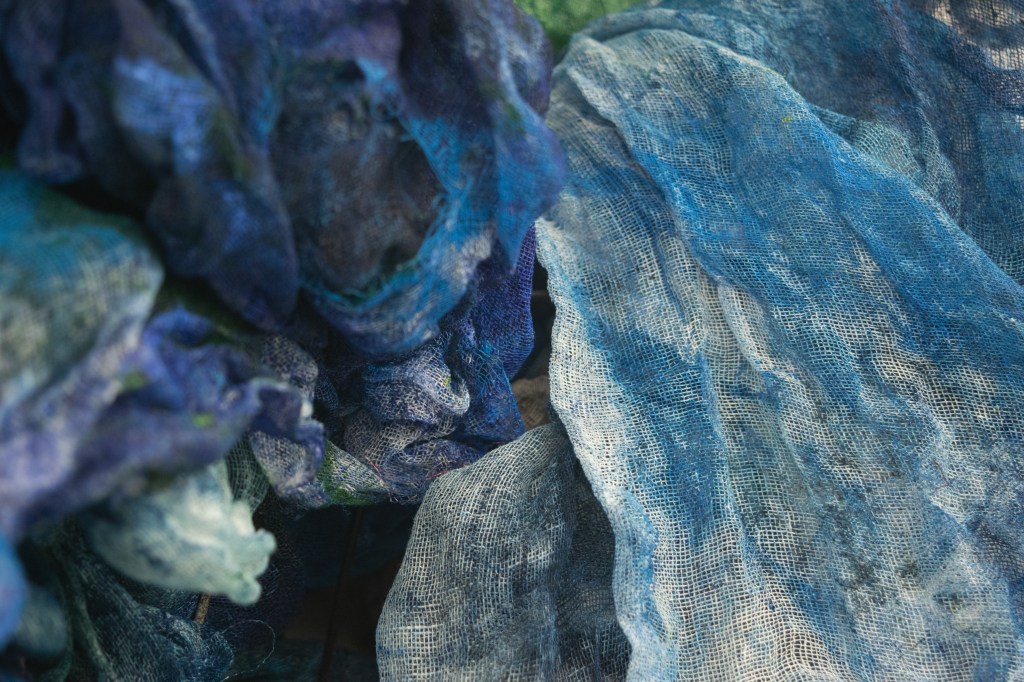
Renovated Website
How to Structure an Effective Typographic Heirarchy
All communication has rules. Writing has rules as down to its bare bones. The bare bones being the size, weight, color, contrast, case, and position. These bare bones allow for a better communication for a piece of writing as like this page we know the title is the title because it is a larger size and is a thicker weighted font compared to this text. Writing’s bare bones are all about typography which when done effectively has a strong sense of hierarchy. This hierarchy is seen in different forms such as in a book where there is the title, subtitles, paragraph text, and captions. Title being the largest in size and possible having the heaviest weight while the caption being the smallest in size.
Interactive Work Response/Review
An interesting piece of interactive art that I found is called 10,000 Moving Cities Same but Different by Marc Lee. This is an augmented piece that shows real time(well about as real time as you can get without going to place cameras/get access to cameras and audio all around these places) cities projected onto basic cube and rectangular prism pieces set in a room. Audio based on the city being shown is also played.

This is interactive as the people who view it get to choose which city they see. Simple in idea/concept but it seems to rely heavily on coding and technological skill. When people choose a city information is looked up and taken to create the atmosphere shift in the room; the text, audio, and visuals come from searching the web about the city chosen.
I find this intriguing but I am curious why the Marc Lee chose to add the boxes in the room. I don’t feel they add anything but dissonance to the work. If that dissonance was the point then it does the job it creates an odd look to an otherwise real showcase of a real-life city.
Curiously I found a site about future architecture and this was on it. Does this mean that the cube-like structures added to it are thought of as future architecture? Is it simply because it shows cities and cities are thought of as the future? Regardless the way this one described the work through me off as it described to process of loading images audio and text as coming from social media which makes this work have a different meaning. It goes from an exploratory way of engaging in virtual reality to a statement about the way we as a society use the internet. If looked at with both those things in mind it’s almost like we are comparing the different ways people approach technology and the availability to communicate with so many different people from far away. Look at the locations that you choose from.
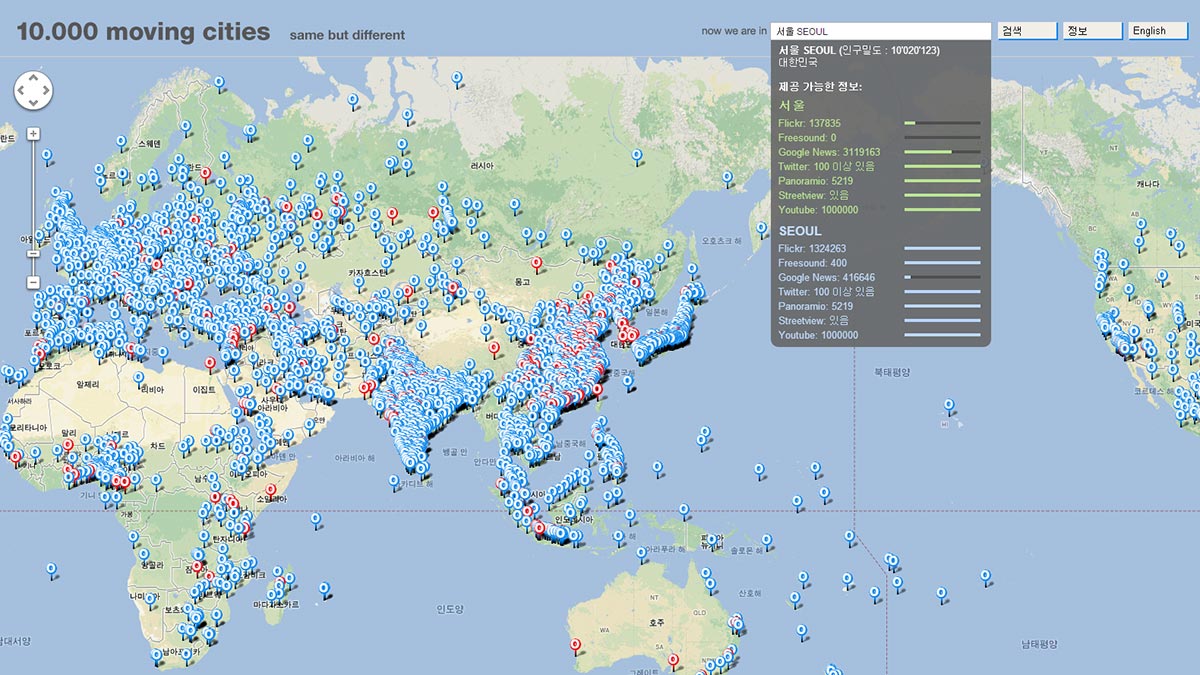
There is obviously more as part of the world gets cut off but look at all the locations we are able to choose from. Its feels nearly infinite. With all the choices there are bound to be interesting differences that can be explored. Simply put the way people post and what they post differs from person to person and from place to place. For example, as a non native to New York I posted photos of me and the people I traveled with in front of any building I could and I posted photos taken while on a ferry. In my hometown/city I post the art I create, the photos I take of family and the responses to things I look into but I rarely post myself. People and location change the way social media is used and because of that we can see some of the differences that we otherwise couldn’t.
Images and references from: http://marclee.io/en/10-000-moving-cities-same-but-different/ http://futurearchitectureplatform.org/projects/4a6a2c9d-e0bc-46e2-b0a5-c2fd3a2bee88/
 Amanda Potts